
Who does a company owe, and how much is still outstanding?
GRISK reconstructs financial and trade liabilities from properties, construction projects and documented transactions, including when the insolvency administrator’s draft schedule of claims is unavailable for review.
In Italian judicial liquidation proceedings, the insolvency administrator files the draft schedule of claims and sends it to creditors and other rights holders who have filed an application. Third parties seeking access to the case file must demonstrate a specific, current interest and obtain authorisation from the supervising judge, who consults the insolvency administrator. Italian Crisis and Insolvency Code, Article 199 · Article 203.
GRISK uses passive intelligence gathering to trace liabilities back to their source. We start with assets and transactions linked to the company and trace the counterparties and payment obligations. We cross-check public registers, records that can lawfully be obtained and documents provided by the client.
What we investigate
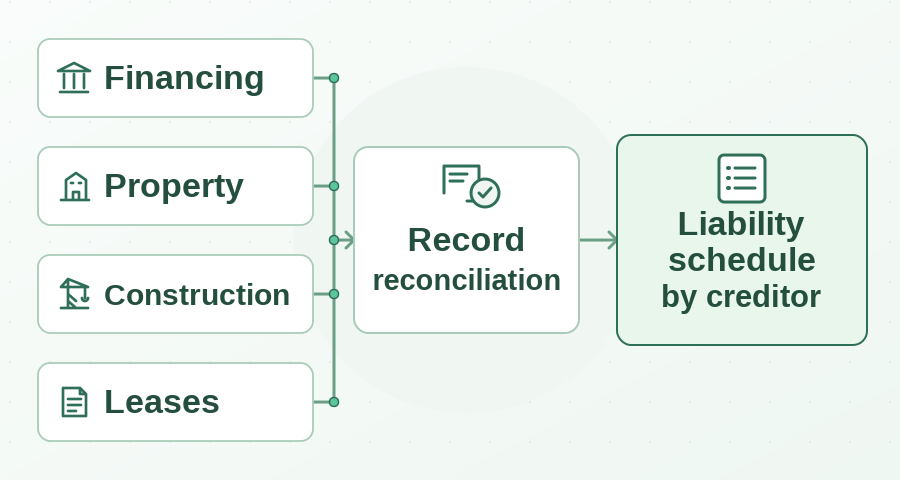
Mortgages, financing and security
We examine property security filings and available financing documents to identify banks, other lenders and any assignees of the debt. We establish the original principal, the financing date, the assets used as collateral and any later entries affecting the registration. Where the documents allow, we take account of repayments, discharge and assignments to estimate the outstanding balance. We report the principal, the registered mortgage amount and any security granted for third-party debts separately. Italian Revenue Agency guidance on property register searches.
Real estate transactions and commercial counterparties
We reconstruct sales, purchases and other real estate transactions to identify sellers, buyers and other contractual counterparties. We extract agreed prices, documented payments, deferred instalments and other obligations owed by the company. For each transaction, we check who the company appears to owe and whether the exposure can be quantified.
Construction projects, contractors and suppliers
We cross-check building, project and commercial documents to establish who worked on each project, including contractors, subcontractors, professional advisers and suppliers. Where the records allow, we identify contract values, progress statements, amounts already paid and any outstanding balances or documented claims.
Leases and other rights to use property
We establish the company’s role in leases, rental arrangements and other rights to use property, identifying counterparties, contract durations, rents and related obligations. We reconstruct any arrears and other amounts payable by the company and distinguish these from amounts it can claim from its counterparties.
When debt reconstruction is useful
When the draft schedule of claims is unavailable and the records need to be examined to identify potential creditors.
Before assessing a claim purchase or deciding how to pursue recovery.
When several mortgage registrations, contracts or assignments may relate to the same liability.
What we deliver
A schedule of identified liabilities by counterparty and an estimate of the total exposure that can be reconstructed as of the review date.
Counterparty and origin of the debt
Supporting records for each entry
Documented amounts and estimates with their basis
Identified liabilities yet to be quantified
How we interpret the amounts
We cross-check payments, discharges and assignments and reconcile liabilities that appear in multiple records. We identify exposures that warrant checking against the case file. Admission of claims and the amounts allowed are verified against the schedule of claims declared enforceable by the supervising judge. Italian Crisis and Insolvency Code, Article 204.
Illustrative example
A property company in liquidation has several mortgage registrations and a construction project underway. Where the records confirm that the mortgages secure the same loan, we group them under one liability. We compare progress statements with documented payments, record the loan balance once and list any outstanding amount owed to the contractor separately.
Need to establish what a company still owes?
Tell us which company you want to investigate, the purpose of the review and, if available, the details of the proceedings or properties and construction projects already identified. We will assess which liabilities can be reconstructed and which documents can support the review.